
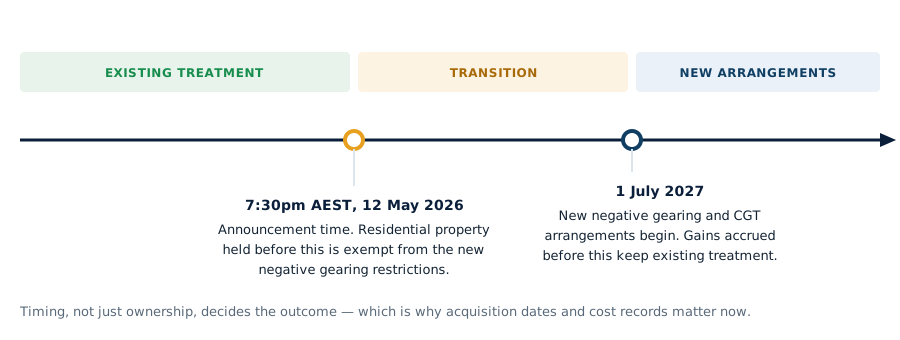
The reforms contain transitional and grandfathering arrangements. Do not assume every investment property automatically loses negative gearing from July 2027 — acquisition date, property type and your circumstances matter.
What is changing, and when
The Federal Government's 2026–27 tax reform package includes significant changes to both negative gearing and Capital Gains Tax (CGT) from 1 July 2027.
Importantly, the rules contain transitional arrangements, so the outcome may depend on when an investment was acquired and the type of property involved.
What's Changing With Negative Gearing?
Under the announced reforms, negative gearing for residential property will generally be directed toward new builds from 1 July 2027.
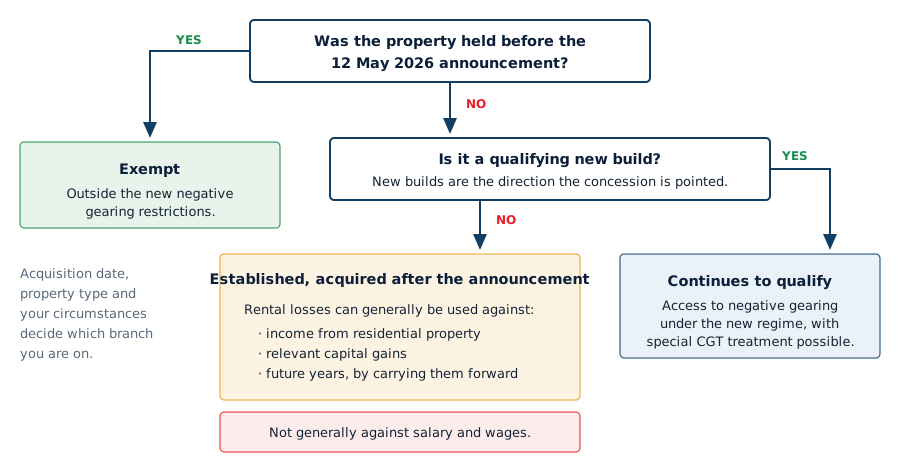
Treasury states that residential properties held before the announcement time of 7:30 pm AEST on 12 May 2026 are exempt from the new restrictions. New builds can continue to qualify under the new arrangements.
For established residential property acquired after the announcement, the treatment of rental losses will change. Treasury says affected investors will generally be able to:
- use losses against income from residential property
- use them against relevant capital gains
- carry excess losses forward
but will not generally be able to offset those losses against unrelated income such as salary and wages.
For a police officer earning a salary and holding an investment property, that distinction could become very important.
Worked Example: The Same Rental Loss, Three Different Outcomes
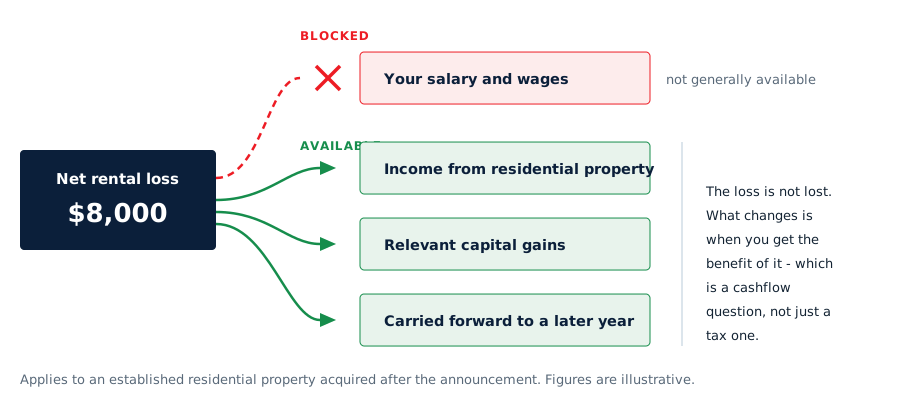
The rules are easier to follow with numbers attached. Take one property, held by three different officers, producing exactly the same result for the year.
Say the property returns $31,200 in rent and runs up $39,200 of deductible costs:
| Rental result for the year | Amount |
|---|---|
| Rent received | $31,200 |
| Interest on the loan | ($27,400) |
| Council rates, water and insurance | ($4,300) |
| Property management fees | ($2,200) |
| Repairs and maintenance | ($1,900) |
| Depreciation and capital works | ($3,400) |
| Net rental loss | ($8,000) |
That $8,000 loss is identical in all three cases. What differs is what each officer can do with it.
Where That $8,000 Can Go
Under the announced rules, the same loss lands in three different places depending on when the property was acquired and what kind of property it is.
| Scenario | What happens to the $8,000 | Effect this year |
|---|---|---|
| Held before 7:30 pm AEST, 12 May 2026 | Exempt from the new restrictions | Can reduce total taxable income, including salary, as now |
| Qualifying new build acquired later | Continues to qualify under the new arrangements | Access to negative gearing continues |
| Established property acquired after the announcement | Available against residential property income or relevant capital gains, or carried forward | No offset against salary, so no reduction in this year |
Illustrative only, and based on the announced design. Your own outcome depends on your circumstances and on the final implementation detail.
For an officer whose main income is a police salary, the third row is the one that changes the arithmetic. The loss still exists and still counts - but not against salary, and not this year.
What Carrying a Loss Forward Looks Like Over Time
Carrying a loss forward is not the same as losing it. It is a timing change, and over several years the picture usually looks something like this.
| Year | Net rental result | Losses used | Carried forward |
|---|---|---|---|
| Year 1 | ($8,000) | $0 | $8,000 |
| Year 2 | ($6,500) | $0 | $14,500 |
| Year 3 | ($3,200) | $0 | $17,700 |
| Year 4 - rent now covers costs | $2,400 | $2,400 | $15,300 |
| Year 5 - property sold at a gain | capital gain arises | up to $15,300 | $0 |
Illustrative figures. The point is the shape, not the amounts.
Two things follow from that. The benefit of the loss arrives later rather than never - and in the meantime the shortfall is funded out of your own cashflow rather than partly offset in that year through your return.
For an officer deciding whether a property is affordable on a police salary, that difference in timing can matter more than the eventual tax outcome.
What Is Changing With Capital Gains Tax?
There are also major CGT changes planned from 1 July 2027.
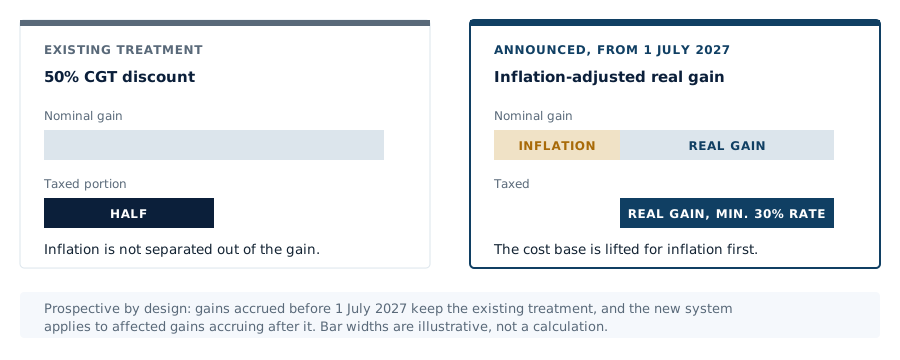
The Government intends to replace the existing 50% CGT discount for affected future gains with an inflation-based system. Under the new approach, the cost base will be adjusted for inflation so tax focuses on the investor's real gain. A minimum tax rate of 30% on real capital gains is also part of the reforms.
The changes are designed to apply prospectively. That means timing matters.
Treasury says gains accrued before 1 July 2027 retain access to the existing treatment, while the new system applies to affected gains accruing after that date.
Worked Example: Nominal Gain Versus Real Gain
The CGT change is the harder one to picture, because it does not simply raise or lower the tax. It changes what gets taxed.
Take a property bought for $620,000 with $28,000 of acquisition costs, so a cost base of $648,000. Years later it sells for $980,000, with $22,000 of selling costs, leaving $958,000. The nominal gain is $310,000.
Under the existing treatment, the 50% discount halves that gain. Under the announced treatment, the cost base is instead lifted for inflation and tax focuses on what is left - the real gain - with a minimum rate of 30% applied to it.
How much inflation there was over the holding period therefore decides the answer:
| Existing treatment | Announced - more inflation | Announced - less inflation | |
|---|---|---|---|
| Net sale proceeds | $958,000 | $958,000 | $958,000 |
| Cost base applied | $648,000 | $792,000 | $690,000 |
| Gain before any concession | $310,000 | $166,000 | $268,000 |
| Concession applied | 50% discount | inflation in the cost base | inflation in the cost base |
| Amount actually taxed | $155,000 | $166,000 | $268,000 |
| Tax on it | at your marginal rate | at least 30% = $49,800 | at least 30% = $80,400 |
Illustrative and rounded. Assumed inflation is a stand-in for whatever the period actually delivers.
Put a marginal rate against the existing column and the comparison sharpens. Assume, purely for the illustration, a 37% marginal rate: $155,000 taxed at 37% is about $57,350. At 45% it is about $69,750.
So in the higher-inflation illustration the announced system produces less tax than the existing one - roughly $49,800 against $57,350. In the lower-inflation illustration it produces considerably more - roughly $80,400 against the same $57,350.
That is the honest answer to whether the CGT change is good or bad for a police property investor: it depends on how much of your gain turns out to be inflation rather than real growth, and on your own marginal rate. Anyone claiming a single direction for every investor is guessing.
The 30% Minimum Cuts Both Ways
One detail in the announced package deserves separate attention: the minimum tax rate of 30% on real capital gains.
A minimum rate does nothing to an investor whose marginal rate already sits above it. But for someone whose income in the year of sale is low - a year of part-year work, extended leave, or a retirement year - a floor can produce more tax than their own marginal rate would have.
Officers who have historically planned a sale for a lower-income year should therefore not assume that timing strategy carries over unchanged into the new system. This is exactly the sort of point worth checking against your own numbers rather than a general rule.
What About a Gain That Builds Up Across 1 July 2027?
This is a fair question and it deserves a straight answer rather than a confident-sounding one.
Treasury says the changes apply prospectively: gains accrued before 1 July 2027 retain access to the existing treatment, and the new system applies to affected gains accruing after that date. So a property bought well before the start date and sold well after it has a gain sitting on both sides of the line.
Exactly how such a gain is split - a valuation at the start date, a time-based apportionment, or some other method - is implementation detail, and it is not something to assume from the announcement material alone. It is a genuine open question rather than a settled rule, and it is one of the reasons keeping dated records now is worth the small effort.
Does This Mean Existing Investment Properties Lose Negative Gearing?
Not necessarily. This is one of the most important points.
The reforms contain grandfathering and transitional arrangements. A property you already own may therefore be treated differently from an established property purchased after the Government's announcement.
Do not assume that every investment property will automatically lose negative gearing from July 2027. The acquisition date, property type and your individual circumstances matter.
What About Buying a New Property?
The distinction between a new build and an established property will become increasingly important.
Treasury has indicated that qualifying new builds will continue to receive access to negative gearing under the new regime, and special CGT treatment may also be available.
If you are considering purchasing another investment property, the tax treatment should therefore form part of your broader financial analysis. Tax should not be the only reason you buy a property, but it can significantly affect the after-tax outcome.
Why Police Officers Should Review Their Property Records Now
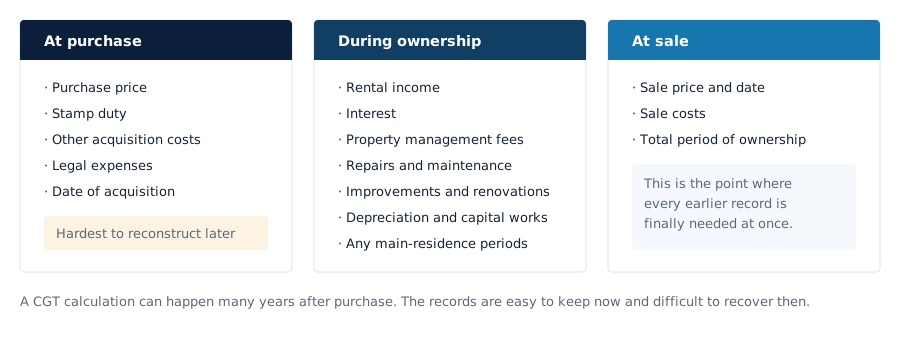
Even though the major changes begin from 1 July 2027, keeping accurate records now can make future calculations much easier.
Property investors should retain information relating to:
- property purchase price
- stamp duty and acquisition costs
- legal expenses
- improvements and renovations
- depreciation and capital works
- rental income
- interest
- property management expenses
- repairs and maintenance
- dates of ownership
- periods where the property was your main residence
- sale costs.
CGT calculations performed years later can become difficult if original documentation has disappeared.
Worked Example: What a Missing Receipt Costs
Record keeping sounds like the dull part of property investment, until it turns up in a calculation.
Take the same sale as above, and add a $46,000 bathroom and kitchen renovation in year three. With the invoices, that $46,000 forms part of the cost base. Without them, it does not.
| Records kept | Records lost | |
|---|---|---|
| Cost base | $694,000 | $648,000 |
| Nominal gain on sale | $264,000 | $310,000 |
| Extra gain exposed to tax | - | $46,000 |
Illustrative and rounded, using the same sale figures as the earlier example.
Under the existing treatment that extra $46,000 of gain is halved by the discount, so roughly $23,000 more goes into taxable income - at an assumed 37% marginal rate, about $8,510 in tax that a shoebox of receipts would have avoided.
Under the announced treatment the missing amount never enters the cost base at all, so it is not only the $46,000 that goes missing but the inflation uplift that would have applied to it. At the 30% minimum, that is at least $13,800 before the uplift is counted.
The renovation happened either way. The only difference is whether it is provable.
Property Values Are Also Moving
The tax changes are occurring against a changing housing market.
Recent Australian economic data has shown softer conditions in parts of the residential property market. That makes it even more important to evaluate property investment based on the full picture rather than tax benefits alone.
Should You Sell Before 1 July 2027?
There is no universal answer.
Selling purely because a tax rule is changing could produce a worse financial result depending on:
- your original cost
- current market value
- outstanding mortgage
- rental yield
- expected future growth
- transaction costs
- existing capital gain
- other income
- future investment plans.
The right decision for one investor could be completely wrong for another.
If you are considering a major transaction, personalised tax and financial advice should be obtained before acting.
Police Officer With an Investment Property?
Investment property tax can involve considerably more than entering your rental income into a tax return.
PoliceTax can help you review rental income, eligible expenses and your overall tax position, particularly as Australia's property tax rules change.
Own an investment property or considering purchasing one? Speak with PoliceTax about how the tax rules may apply to your situation.