

Private health insurance premiums are generally not an ordinary tax deduction. The tax effect usually comes through the Australian Government rebate, the Medicare Levy Surcharge and reconciliation of any rebate already received through your fund. Check the ATO Medicare and private health insurance guidance or ask a registered tax agent before lodging.
Does private health insurance reduce your tax?
Private health insurance is generally not claimed like a uniform, work equipment or another eligible work-related expense. It can still affect your return through the income-tested private health insurance rebate and the Medicare Levy Surcharge (MLS).
Depending on your income and age, the government rebate may reduce the premium you pay during the year or be claimed through your tax return. Your actual entitlement is reconciled when you lodge.
The Medicare levy and Medicare Levy Surcharge are different
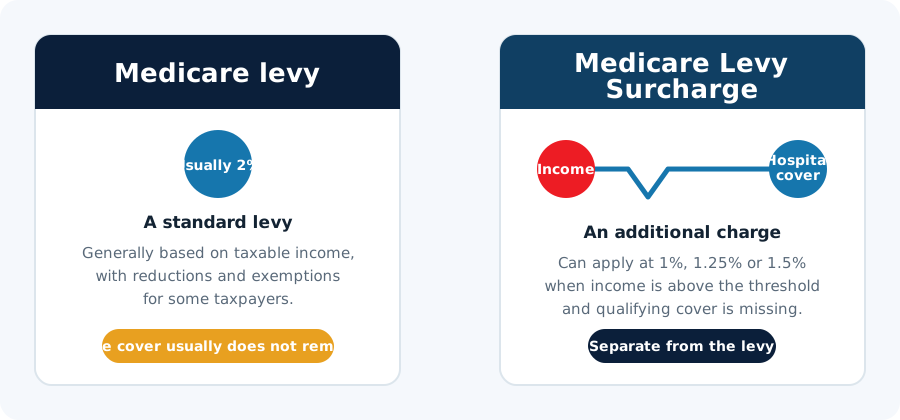
Most Australian taxpayers pay the ordinary Medicare levy, generally calculated at 2% of taxable income, subject to low-income reductions and exemptions. Having private health insurance does not normally make that standard levy disappear.
The MLS is an additional charge of 1%, 1.25% or 1.5% that can apply when income for MLS purposes is above the relevant threshold and you, your spouse or a relevant dependant do not have appropriate private patient hospital cover.
2025–26 Medicare Levy Surcharge thresholds
For the return covering 1 July 2025 to 30 June 2026, the following income-for-MLS-purposes thresholds apply. For families, each MLS dependent child after the first increases every family threshold by $1,500.
| Income tier | Single | Family | MLS rate |
|---|---|---|---|
| Base tier | $101,000 or less | $202,000 or less | 0% |
| Tier 1 | $101,001–$118,000 | $202,001–$236,000 | 1% |
| Tier 2 | $118,001–$158,000 | $236,001–$316,000 | 1.25% |
| Tier 3 | $158,001 or more | $316,001 or more | 1.5% |
2025–26 thresholds. Family thresholds increase by $1,500 for each MLS dependent child after the first.
Explore the 2025–26 MLS tiers
Choose a family status and income to see the corresponding 2025–26 threshold tier. This is general information, not a personal tax calculation.
- Base tier · 0%Base threshold
- Tier 1 · 1%Tier 1 threshold
- Tier 2 · 1.25%Tier 2 threshold
- Tier 3 · 1.5%Above Tier 2
Select your details to explore the threshold tiers.
The explorer is an educational threshold guide only. It does not decide whether you are liable for MLS or calculate the amount on your assessment.
A simple police officer example
Consider a single police officer with no dependants whose income for MLS purposes is $108,000 and who did not hold appropriate hospital cover during 2025–26. They fall into Tier 1, where the rate is 1%.
If the amount to which MLS applies is also $108,000, a simplified illustration is $108,000 × 1% = $1,080. That is in addition to the ordinary Medicare levy.
The real calculation depends on the person’s taxable income, reportable fringe benefits, family circumstances, cover dates and any exemptions. Income for MLS purposes identifies the tier, but the surcharge is not necessarily applied to every component included in that income test.
Your MLS income may be higher than you expect
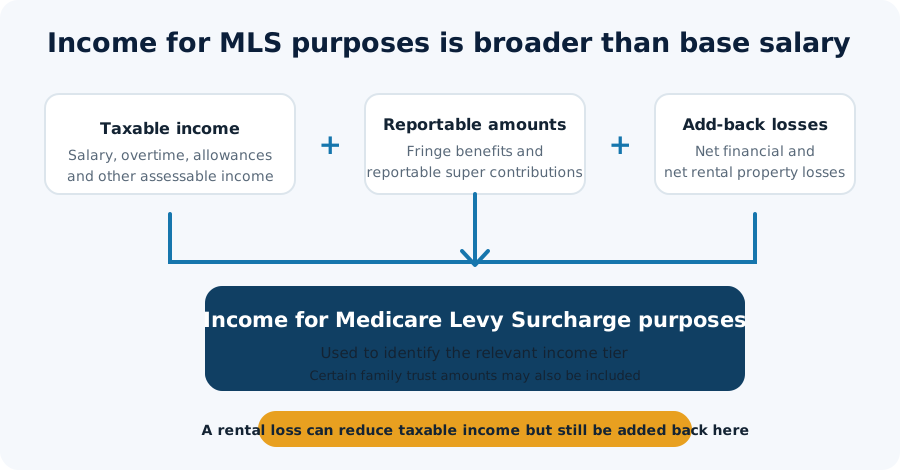
The threshold is not based only on base salary. Income for MLS purposes can include taxable income, reportable fringe benefits, reportable employer super contributions, deductible personal super contributions, net financial investment losses, net rental property losses and certain family trust amounts.
A rental property loss may reduce taxable income, but the net rental property loss is added back for the MLS income test. Being below $101,000 in taxable income therefore does not automatically put a single taxpayer below the 2025–26 MLS threshold.
- Overtime, shift penalties, court attendance and higher duties can raise taxable income.
- Salary-sacrificed or other reportable employer super contributions can affect the income test.
- Net investment and rental property losses are added back for this purpose.
- A second job, promotion or investment income can move an officer into another tier.
What type of cover avoids the MLS?
You generally need an appropriate level of private patient hospital cover from a registered Australian health insurer. For MLS purposes, the excess must be $750 or less for a policy covering one person, or $1,500 or less for any other policy.
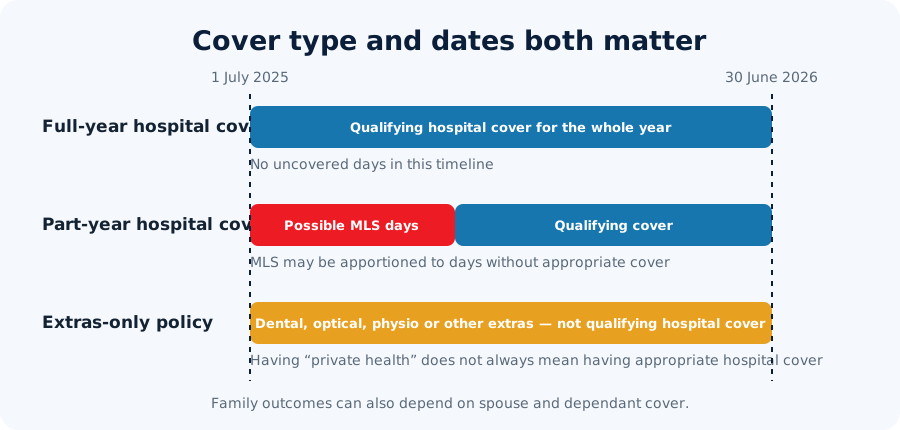
Extras cover for dental, optical, physiotherapy or chiropractic treatment is not private patient hospital cover. Someone can have private health insurance and still be liable for MLS if the policy is extras-only or otherwise does not qualify.
What if you only had cover for part of the year?
Dates matter. If your income is above the threshold and eligible hospital cover started part-way through the year, MLS may still apply for days without appropriate cover. Cancelling or suspending cover can have the same effect.
For couples and families, the position can also depend on whether your spouse and relevant dependants had appropriate cover. Telling your accountant only that you “have private health” may not provide enough information.
Why private health insurance can create a tax adjustment
When your insurer reduces premiums using a nominated income tier, that rebate is effectively reconciled against your actual entitlement after you lodge.
If the premium reduction was larger than your actual entitlement, some rebate may be repaid through the assessment. If it was smaller, you may receive an additional tax offset. A busy overtime year, promotion, second job or investment income can change the outcome.
Check the information before lodging
Private health insurance information is generally pre-filled into myTax and tax-agent software, but you should still check it. Contact your health insurer if details are missing or appear wrong.
- Did you have qualifying hospital cover or only extras?
- Were you covered for the whole financial year?
- Were your spouse and relevant dependants appropriately covered?
- What is your income for MLS purposes, not just base salary?
- Do the pre-filled insurer ID, membership, premiums, rebate, benefit codes and cover days match your records?
What changes for 2026–27?
From 1 July 2026, the base threshold is $105,000 for singles and $210,000 for families. Single thresholds are Tier 1 from $105,001 to $123,000, Tier 2 from $123,001 to $164,000 and Tier 3 from $164,001. Family thresholds are $210,001–$246,000, $246,001–$328,000 and $328,001 or more.
Those amounts apply to 2026–27, not the 2025–26 return discussed above. If income is changing this year, review your current cover and income position using the rules for the correct financial year.